Political Bias and Temporal Dynamics in Large Language Models
Most studies measure an LLM's political bias once, as if the model never changed. We treat bias as something that moves, and track how it shifts across model generations, sizes and alignment stages.
Research questions
- How does political bias in LLM outputs change across successive model generations?
- Do safety alignment and red-teaming line up with shifts in political stance and sentiment?
- Are these changes uniform across regions and political figures, or uneven?
Method
We extend target-oriented sentiment classification (Elbouanani et al., 2025). Each of 60 sentence templates has a placeholder X, such as "X issued a statement on the matter.". We fill it with each of 250 political figures, balanced across Africa, Asia, Europe, North America and South America and across the left–right spectrum. Every model receives the same 9-shot prompt and must label the sentiment toward the person as positive, neutral or negative.
An unbiased model should give the same label whoever's name is in the sentence. We measure this with Prediction Inconsistency (IC), the label entropy for each template averaged over all templates. To track change over time, we compare model versions within each family on three measures: Bias Velocity (the rate of change between releases), Alignment Delta (chat model vs. base model) and Cross-Family Convergence (whether families end up at similar levels).
Results
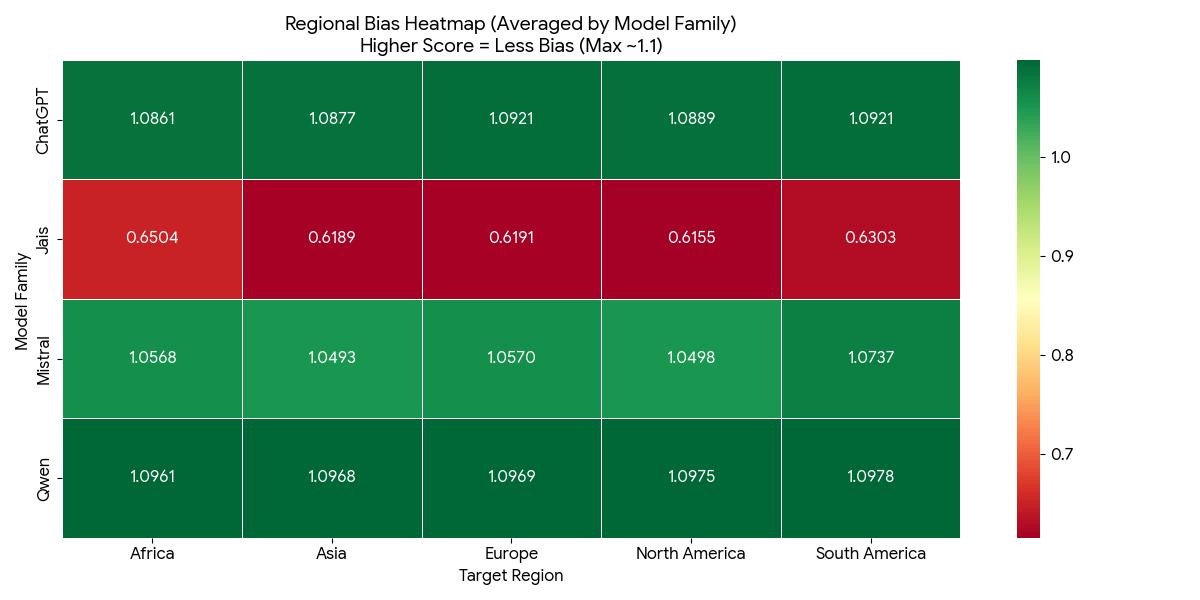
- Three tiers: Qwen and ChatGPT come close to the maximum (IC ≈ 1.09). Mistral sits in the middle and leans Western (1.02–1.08). Jais shows strong polarity (0.60–0.65).
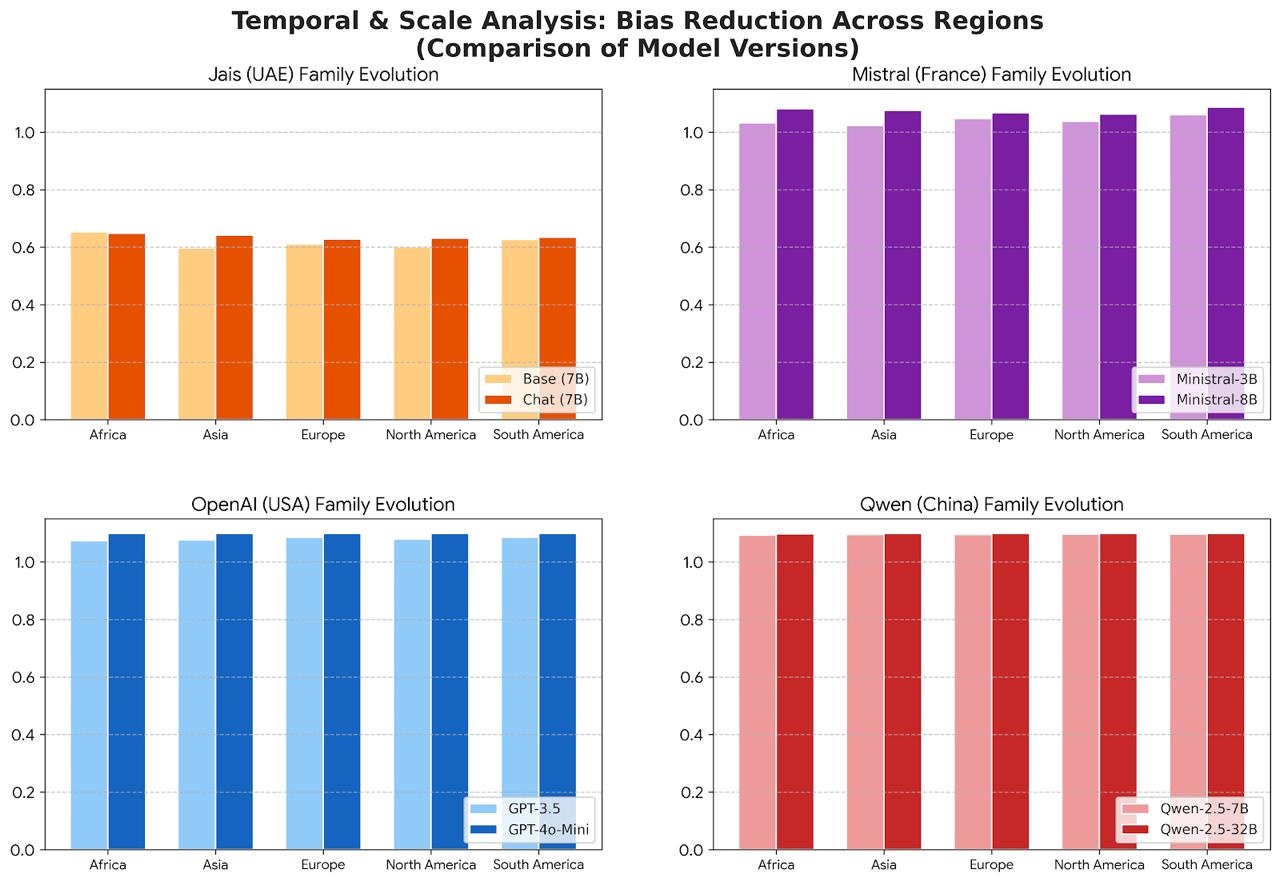
- Newer models even out across regions: going from Ministral 3B to 8B gives the biggest gains for Africa (+0.049) and Asia (+0.053), and much less for Europe (+0.019). GPT-3.5 → GPT-4o-mini shows the same pattern.
- Alignment is targeted: Jais-Chat improves on Jais-Base for Asia and North America but slips slightly for Africa.
My contributions
First author. I worked on the longitudinal evaluation framework, the shared pipeline that runs API and local models the same way, and the analysis.